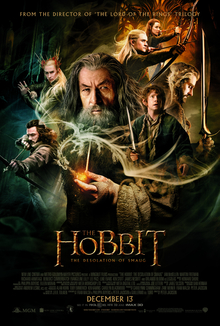
Before going into the most recent installment of Peter Jackson’s The Hobbit, my preconceptions of it were not dissimilar to my preconceptions of The Hunger Games, based on the quality and reception of the first film. Film one was undeservedly revered by many, and was merely an unexceptional, mediocre and generic film for its genre praised largely because of the popularity of the source material. Unlike the second Hunger Games film, however, The Desolation of Smaug fails to improve on the first, and is simply more of the same. As a result, I can recycle my opinion of An Unexpected Journey from last year, for all to enjoy.
Possibly the most common criticism of the film hinges on its remarkable ambition. I am far from the first, let alone the only one, to point out that there is barely enough material for one film within J.R.R. Tolkien’s The Hobbit, let alone three films - and let alone again, three films that are three hours long apiece. While I don’t think that is the main reason for the film’s lack of quality, it certainly doesn’t help, and could easily have been averted if Jackson had handled the story well. However, I admire his ambition to a certain extent, and his aspiration to expand the story from the Silmarillion and - I’m sure - various other backstory texts.
The main reason I like his rendition of the Lord of the Rings is not for how well he executed the film, but because of how the world was built. What created the intrigue of the Lord of the Rings was the lingering, underlying sense that we were part of a much larger story beyond even the mere hope of comprehension. It was the implication that this entire conflict was merely a few moves within a cosmic chess game, hinted from Gandalf’s regular disappearances to attend to other matters among other things. It truly was an epic, and we could feel it too. The Hobbit, by contrast, is not an epic. It is merely an introduction, setting the scene for what is to come; yet Jackson appears to have set out to (somehow) make it out to be even bigger than the Lord of the Rings. It would almost be ludicrous were it not for the frankly absurd amount of money sunk into its production, money which could certainly be better directed. But, of course, his attempts to inflate the importance of this story fall flat, and appear disingenuous at best, because the events in The Hobbit are not as inherently crucial or important as Jackson would like us to think. It is an inconsequential series of insignificant happenings with only accidental and incidental relevance to the meat of the larger story - for example, the finding of the Ring. The Dwarves’ quest is of little overall significance, but Peter Jackson clearly wants us to believe it to be at least equal to the Lord of the Rings.
His agenda is not very convincing for a number of reasons, but the most important point here is this: nothing in the story has any weight. There is an unnatural emphasis of theatrics and presentation, to make things seem important without making them feel important to the viewer. One obvious example is the dialogue, which is contrived, stifled and unnatural; every character speaks either in riddles or overly poetically. Obviously most people don’t speak like this, and so the entire film cannot be expected to feel real or natural on any level.
Films are obviously pre-rehearsed, scripted, planned, predetermined, and heavily edited such that the final product is as smooth and flawless as possible. The magic of a good film, and thus the talent of a good director, is when it permits the audience to forget this - I believe “willing suspension of disbelieve” is the correct term. It is for this reason that films must appear natural, and this is something at which Peter Jackson’s The Hobbit spectacularly fails, specifically by presenting itself as a over-melodramatic stage play. The dialogue is but one instance, but also quite surprisingly bad acting, with many famous actors, who are usually much better than this, appearing to be more-or-less phoning it in - Christopher Lee, Orlando Bloom, Hugo Weaving, and particularly Cate Blanchett to name a few - all very stiff, stifled, or sometimes over-melodramatic. Possibly the most notable example that comes to mind is a scene from the first film, where Galadriel is introduced for the first time; she turns to face the camera with sunlight glowing from behind her, in a completely symmetrical and perfectly framed set, the wind in her hair and uplifting orchestral music framing the shot. Anyone who has seen the film will know what I am talking about, and will understand my distain for the contrived and over-rehearsed nature of it. It’s surreal; it’s unnatural, and it’s too obviously faked - and even better, the entire film is like this. And now The Desolation of Smaug can sing along.
The Lord of the Rings suffered from this as well to a point, but was saved because of the inherent weight of the story’s great scope. It didn’t matter how well the story was executed because the story itself was compelling regardless. The Hobbit doesn’t have this benefit, and thus cannot rely on it, no matter how hard Jackson tries to conjure it from thin air.
These are far from the only issues. With no apparent reason for doing so, The Hobbit erratically and schizophrenically flicks between sincere drama and slapstick comedy, failing to decide on one or perform either adequately. The result is a messy film with no idea of what it wants to be. With the sincerity watered down somewhat by poor directorial decisions previously mentioned, and childish slapstick comedy (which I would call “cheap humour”) eliciting the occasionally mildly amused chuckle at best, if that, I’d say all we have on our hands is a generic, mediocre fantasy flick with an overinflated ego.
Other than this, a word must be reserved, once again, the characters. There are thirteen main characters, and over all perhaps two of them are developed at any length or with any depth - one of which being the dwarf leader whose name escapes me. The rest are mere one-dimensional caricatures with no identity of purpose; I don’t even remember most of their names. There are simply too many, and the film becomes too thinly spread as a result. I am fully aware that it is part of an accurate rendition of the book, however to me this is no excuse. It simply reflects the unsuitability of the source text for film adaptation as it stands.
As far as I can tell, the only redeeming quality of these films is Martin Freeman’s acting performance, which is remarkably by any standards. his experience from much of his resume as the “everyman” - particularly The Office, is perfectly suited for the role of Bilbo Baggins, and highlights far more than anything Peter Jackson did the theme I hinted at earlier: being caught up in an incomprehensibly massive conflict against one’s will. It is a recurring theme in the Lord of the Rings, but is central to The Hobbit. In a way, Freeman’s casual acting style reflects the audience, with his ability to act naturally and impulsively painting his character as being the most genuine and real. He mirrors how most of us would feel in similar circumstances, as ordinary people ourselves.
A final word on magic in fiction. By definition, magic should be able to solve all problems faced by characters in a work of fictions - it is, after all, a defiance of the laws of nature, under which anything applies. Obviously, if this were taken at face value by writers, there would be no story as any conflict could be resolved within five minutes, and without conflict or struggle how could such a story be compelling? This is a serious narrative issue in any fantasy story - there must be reasonable restrictions placed on the use of magic such that challenge is not eradicated, and above all they must be explained. This is something I found lacking in The Hobbit: there is a scene toward the end of Part One where the dwarves and Gandalf are stuck in a tree balancing horizontally over the edge of a cliff. There is absolutely no reason to believe, what with his previous demonstrations of magical prowess, Gandalf could not have simply lifted the tree upright within few seconds. Alas, he resorts to summoning giant eagles instead, after much “struggle”. Willing suspension of disbelief is completely absolved and the film loses all ability to be compelling. Magic should be used with caution in writing, else there is no good reason to believe the characters could not wish away all their problems and be home in time for lunch.
The only conclusion which can really be reached on The Hobbit is that it is, simply, poorly directed. In an interview with the BBC, Peter Jackson stated that he believed the main quality of his films to be “authenticity” [sic], which is odd, because authenticity is precisely what these films shamelessly lack. I’m not claiming all films need to be realistic, but they should at least be believable to a reasonable degree, and not look like a middle school drama production. The Hobbit has simply been misdirected and mishandled by Jackson, resulting in a messy, inconsistent, contrived and - above all - boring film made out of a once great story.
