Thursday, 25 April 2013

MUSIC: Sempiternal - Bring Me The Horizon


Bring Me The Horizon is a band I have generally tried to avoid, as I have done with metalcore in general, because I do not like the general scene associated with the music. I have tried to appreciate hardcore and metalcore in the past - in my metalhead days, when I had friends who listened to metalcore and would try to get me into the genre - but I never managed to seriously enjoy it much.  Generally, most metalcore bands seem to employ a combination of hardcore punk and heavy metal, but in doing so they utilise the inferior characteristics of both, resulting in something fairly mediocre. It carries neither the raw, powerful stripped-down sound of punk, nor the heavy, rich and dynamic sound of metal, and as such is inferior to both. The reason the genre has taken off of late is no mystery - metalcore is far simpler and less subversive than its roots, making it easier to swallow  and consume for the masses.

Sempiternal is British metalcore band Bring Me The Horizon’s fourth studio album, and before I go on I feel I should give due credit to the album artwork - depicting the Flower of Life - which I think is quite amazing. It is very intricate and well-designed, aesthetically balanced and overall very interesting. Thus far, Sempiternal is the only Bring Me The Horizon album I have ever listened to, so I cannot compare it to their previous work. What I can tell, however, is that for the most part it is not a lot more than generic metalcore. It is a standard monotonous combination of screamed vocals, distorted heavy guitars, dark repetitive rhythms, and an overproduced clean sound.

Allegedly, it employs innovative use of electronic and ambient music influences; however, upon listening it merely switches between generic metalcore, and either pop, electronic or even dubstep at times. The drum kit sounds fake and synthesised, as if it were from a dubstep song. While this may have potential to do something interesting and innovative, Bring Me The Horizon fails to bring anything new and of value to the table with any of these new influences, due to the bland and derivative ways in which they incorporate them, and thus their attempts to freshen their sound fall short. Sleepwalking sounds more akin to modern pop, such as Katy Perry, Lady GaGa, Owl City, or Justin Bieber, in stark contrast to the brutal hardcore image the band attempts to carry. 

I have always labelled the hardcore and metalcore scene as “pseudo-punk-rock”, as it completely inverts the original philosophy and ideology of punk-rock. While punk was originally about defying the status quo and forming your own identity, metalcore nowadays appears to be about following a trend and a new status quo, where the bands’ hairstyles and skinny jeans are more important than musical and artistic innovation. I say this, because Sempiternal is hardly a deviation from this trend. Anything that is made must be unique in some way; else it can too easily be substituted for something which already exists, and therefore has no reason to exist in the first place.

According to Wikipedia, one band credited with influencing metalcore is Sepultura, a Brazillian heavy metal band whose 1993 Chaos A.D and 1996 Roots albums are not only similar to many metalcore bands of today, but also superior, with an engaging use of dynamic variation, balance, subversion and complexity, a raw, organic sound, and an overall unique sense of purpose. It is interesting to note stylistic similarities between Sepultura and Sempiternal, especially when the latter emulates the former so poorly. Both utilise downtuned guitars, a heavy rhythm-driven style, screamed vocals and dark atmosphere; however Sempiternal is monotonous, repetitive and stale, and this is partially attributable to the excessively clean production. An overdriven and distorted guitar once sounded heavy, dirty, and coarse; now with modern technology, we have managed to make guitar distortion sound cleaner and smoother than ever. As I mentioned in my March Fires review, an excessively clean production sound gives the music a mechanical and cold feeling, as though it was preprogrammed by a computer, and all humanity and soul is filtered out by the production. The music therefore loses all sense of purpose, as it no longer resembles the artistic expression of one or several human beings, but merely another product churned out by a machine. The production sound on Sempiternal eliminates all dynamic diversity, resulting in the aforementioned monotonous sound, and it is thus boring to listen to.

Sempiternal can also be compared unfavorably to another, older band - Slipknot, a surprisingly great band. At times, Oli Sykes’ vocal style reminds me of Corey Taylor in his early days, in parts of Shadow Moses in particular, and the heavy rhythmic guitar and double-kick drums in unison is not too dissimilar from Slipknot. However, Sempiternal lacks the primal aggression, anger, and raw emotion present in Slipknot’s music, mostly due to the clean production sound, which makes the music sound tame, filters out the raw emotions and leaves us with just noise with no weight behind it.

It’s not only the production sound. The screamed vocals are monotonous in themselves - they are empty and carry no weight, mostly due to overuse. Literally 90% of all vocals on the album are screamed, and the effect does wear thin with every use. I mentioned subversion before, which I wish to elaborate on. Subversion, i.e. doing something unexpected and contrary to the listener’s presumptions, is the only thing needed to make something which was once boring, interesting. This is another aspect I mentioned in my review of March Fires, where one track (Horizons) needed a minor-second interval thrown in to create some dissonance. That is one example of subversion. Sempiternal has no subversion - everything is played straight and to the end, and there are barely any syncopated drum rhythms, dissonant melodies or unexpected chord progressions. This makes the album predictable, and if it’s predictable it needn’t exist - we’ve heard it before. Which brings me to another criticism: many of the songs are instantly catchy. This rings loud alarm bells for me. If a song is catchy, it means it’s simple and repetitive enough to be stuck in one’s head after a mere few listens. This in turn implies a lack of creativity, complexity, and imagination inherent in the music. Shadow Moses is a particular culprit, which despite being little more than mediocre, has been stuck in my head for quite some time. 

Another metalcore trend observable in Sempiternal is the shallow lyrics, mostly concerning “first-world problems” and teen angst, which makes the music seem disingenuous. Sleepwalking, Seen It All Before, And The Snakes... in particular carry this theme, and there are too many individual lines to quote in this review. Occasionally, the band attacks religion in their lyrics, which earns them points in my book; however they merely gain ideological points, rather than artistic points, and such subject matter is subjective at best. Additionally, their attacks of religion are neither new nor particularly enlightening, merely a repetition of common criticisms. The House of Wolves appears to point out religion’s destructive tendencies and corruption, with “I’ll bow for your king when he shows himself,” “Show me a reason to think my soul can’t be saved if I sell you my sins,” and of course, the chorus. While these are all valid criticisms, they bring nothing new to the table. Similarly, Crooked Young is a rather explicit attack on religion, however it fails to make a fresh impact and instead repeats what has already been said. 

Despite this, or perhaps in spite of it, one thing Sempiternal does do well is synchronize the lyrics with the music. The tone of the music fits perfectly with the tone of the lyrics for the most part, which is something I have mentioned previously, and as such there is a strong sense of unity within the album. This does increase the power and impact of the music, although it barely compensates for its inherent mediocrity in the first place. One song I actually like is Anti-Vist, for this reason. I have an ideological affinity with the lyrics in the song, and there is a genuine and powerful emotion which is captured in every element of the song, music and lyrics. Anti-Vist is the only song on this album which makes me feel anything, and my personal favourite. Even though I agree with the premise of the song, the lyrics are still shallow and immature, and I can’t help but feel that I’ve heard everything in it before, in other, better music, but I still appreciate it nonetheless. It’s also hilarious to hear the word “fucked” bring out Oli Sykes’ Yorkshire accent. 

So Sempiternal isn’t all bad; however, in quality, depth or complexity it barely matches many of it’s stylistic predecessors, and as such is nothing more than an inferior replica of older bands - and if that’s the case, it really needn’t exist. And while I do feel metalcore is a step forward for mainstream scene, it is a vast step backward for the alternative scene - and yet another generic metalcore album, even one which attempts to experiment with other styles like Sempiternal, does little more than fuel the decline of modern alternative music. 

Thursday, 18 April 2013

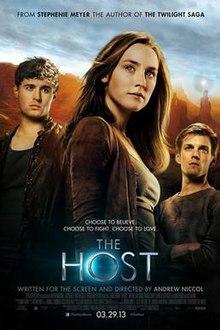
FILM: The Host


The trouble with film adaptations of popular literary works is that fans of the original book place such strong emphasis on recreating their favorite text - as a result, any deviations from the original story a film adaptation may take are harshly criticized by audiences. Placing such high priority on simple recreation of a text is problematic for a number of reasons; namely, the audience will ignore or dismiss an inherently good film simply because it fails to capture the original story exactly. More often than not, the medium translation simply will not allow an exact replica of a book, and adjustments are necessary. Other times, filmmakers seek not to regurgitate a popular story, but to deliberately change it in order to tell the story their own way. Whether or not a film adaptation of a book takes liberties with the original text is irrelevant - unfortunately, claims that “the book is better than the film” are blinded to this fact. Adaptational films are not judged on their own merits, and are instead judged on the basis of whether they follow the source text accurately. Fortunately, I never read Stephenie Meyer’s The Host, so I went into the film able only to judge the film independent of the original novel - which I believe is the only way to judge a film adaptation.

The Host is an adaptation of Stephenie Meyer’s novel of the same name, who also wrote the Twilight series of novels. Meyer’s affiliation with Mormonism has undermined her credibility to an extent, with Twilight supposedly intended to be a metaphor for the virtue of purity and fidelity, (which kind of failed with the ensuing fanbase) so I went into The Host partially wondering where the Mormon significance lay. With a lack of knowledge of the nuances of Mormonism, though, it was difficult to spot; additionally, the possibility that the filmmakers subordinated the religious point was present.

The Host is a film by Andrew Niccol, who also directed Gattaca in 1997, set in a post-apocalyptic future where an alien parasitic race has invaded to possess and utilise human bodies in order to build a perfect utopia on Earth, of eternal peace and free of war, hate, and conflict. Unfortunately, being possessed by these aliens (who are referred to as “Souls”) renders the human unconscious, and therefore nothing more than a vehicle for the Souls. Melanie Stryder is a young woman captured by the colonial aliens and infected with a Soul named Wanderer. However, for some reason, Melanie remains conscious throughout her possession by the Wanderer, and as such can communicate with Wanderer with her thoughts, attempting to dissuade it from following its duty to the colonisation effort. This is a concept I found surprisingly compelling, and I found these dark undertones thoroughly intriguing from the beginning of the film.

However, this is a film I found particularly difficult to classify; at times, it feels like a thriller, at others it feels like a drama, a science-fiction, a fantasy, and even a romance. Rather than attempt to blend the above genres together, the film has opted instead to cycle through them, resulting in several jarring tone shifts and an altogether inconsistent feel. The opening played like a thriller, with a fitting soundtrack and a commendable use of tension - however, not ten minutes in, once Melanie was captured and infected, the music score shifted to an uplifting piece, all tension was gone and the film became a fantasy. After one hour, it shifted to romance. I can’t shake the feeling that if the film maintained a consistent tone, it could have been quite excellent.

In addition to the inconsistent tone, or perhaps in spite of it, the film doesn’t appear have a central focus. I couldn’t tell whether the main point of the film was the concept of colonisation, the inner conflict between Melanie and her brain parasite, the importance of thinking differently and doing what’s right, the human rebellion’s struggle or the romance. As a result of this lack of focus, none of these aspects were particularly compelling. Each and every one of these concepts (with the possible exception of the romance) is a great opportunity for in-depth exploration individually, but the film’s attempt to focus on all of them results in a failure to focus on any of them.

For example, I felt a great opportunity was missed to explore the inner conflict and dual personality between Melanie and Wanderer. The latter is completely and utterly dedicated to the Souls’ colonization cause, and Melanie is entirely devoted to stopping Wanderer and by extension, the entire alien invasion. Both characters fit neatly on opposite ends of the sliding scale of idealism versus cynicism, with Melanie representing idealistic humanism and empathy, and Wanderer representing cynical misanthropy and cold execution of duty. There are reasonable cases on both sides, and this could have been a fantastic opportunity to explore an ideological struggle between the two minds in the one body, with the duality the sole link between the two species. But no - Wanderer changes heart within the first half hour or so, and that whole idea is abandoned almost instantly. There is no dialogue whatsoever showing why Wanderer would switch sides, and as such the character fails to be believable in the slightest.

Initially, I thought The Host was inherently cynical, as it portrayed the utopia resulting from the alien invasion in a primarily negative, distinctly Orwellian light. However upon reflection, The Host appears to lean more on the side of idealism, with quips about hope and retribution of humanity. In fact, this film is so incredibly idealistic that it borders on sickening, with the overall conclusion that humanity can strive to overcome it’s flaws, which is naïve at best. The problem with “inspiring” tales such as this one is that their hopeless idealism comes across as unrealistic and unattainable, and therefore fails to inspire, which is why an explicit conflict between these two perspectives is necessary for either one to be believable. Actually, I can’t recall any conflicting dialogue between any characters. There’s conflict of interest, but it isn’t resolved convincingly. Within five minutes of screen time, any conflict you may have seen has been resolved and forgotten, somehow. This is not good storytelling. For us to feel any sense of connection and affinity with film characters, they need to be plausible human beings, and not one-dimensional plot devices (as most of the characters in The Host are).

The novel has been marketed as a romance for several years now, and as such it’s fitting that a major part of the film is the romantic interactions. It should not be a surprise, then, that the romance is the least interesting aspect of the film, while being the most prominent. There is a very simple reason for this: romance by its very nature is a deeply personal thing. When portrayed in multimedia, it is either too specific to the depicted characters to be relatable, or too generic and clichéd to be believable. In both cases, the romance fails to be interesting. Before I go on, I should mention that the Souls are completely gender neutral, and are assigned no gender other than that of the body they happen to be possessing at the time - thereby, it makes no sense that a human male should fall in love with it, and even less that it should happen to return said love.

It is a shame that romance is portrayed as central to the film’s concept, because it’s also the most boring part of the film. The Host relies entirely on sentiment for it’s weight, but forgets to establish it’s characters in the first place, making it impossible for the audience to care about the characters and hence the sentimentality fails tremendously. If we, the audience, have no emotional investment in the characters, then any attempt at sentiment will fail, and we cannot have emotional investment in characters which are one-dimensional and incomplete.

As a result, the romance is incredibly boring. Whenever a romantic scene played on the screen, with love interests interacting as they do, all I could think was “am I supposed to care about this?” And if I am asking this question, the film has obviously failed in its purpose. Moreover, the characters themselves are shallow, and I think there’s a compelling case to be made about The Host objectifying women. While the male characters were previously hostile to the Souls, submitting the human race to cold-blooded assimilation and genocide, the minute it possesses the body of an attractive young woman the men turn soft and affectionate. One even goes so far as to fall in love with Wanderer. It makes no sense, and it is made more confusing with the fact that both male love interests look and act almost identical to each other, and it took me a while to fully understand what was going on. The ultimate flaw in this regard, however, is this: it attempts to portray love as central and important to the film, but fails to understand what love really is - other than an elementary, shallow, high-school-drama understanding of the concept. As such, it kind of plays like Twilight: future edition. 

The Host starts out with an intriguing premise, but falls short by focussing on petty romance and sentimentality to propel it, rather than the big picture themes which are presented but not resolved. It is therefore a shallow and boring film which doesn’t really have a place in the modern film industry. That’s not to say it’s not worth a look if one happens to be curious, as it does have some interesting ideas happening, but it’s not worth paying for. See it for free if you can, otherwise I cannot recommend.

Thursday, 11 April 2013

MUSIC: March Fires - Birds of Tokyo


After doing my Nick Cave and David Bowie reviews, I realised it was a good idea to familiarize myself with an album by listening to it several times before typing my opinion. On paper, this seemed like a viable tactic, because in case I change my mind partway through writing a review, revising my own opinions is tedious and difficult work. However, for March Fires I definitely regretted this decision, as all I wanted to do was stop listening to it, and this did not change no matter how many times I listened to it. Generally, this is not a good sign.

Birds of Tokyo are a relatively new Australian band previously known for their 2007 debut Day One and their 2008 follow-up Universes, both released independently through MGM Distribution. The former was a raw, organic alternative-punk sounding album which, although uncertain of its identity and purpose, was no doubt a quality piece of music, and showcased the band’s potential at the time. The band resolved these identity issues with an outstanding follow-up album, Universes, full of depth, atmosphere, subversive songwriting, dynamic tension and, overall, soul. 2010, however, saw Birds of Tokyo release a self titled third album through EMI records, complete with ultra-clean production, catchy pop tunes, and generally everything good about the band removed for the sake of accessibility. Effectively, Birds of Tokyo reduced themselves to nothing more than yet another drone calibrated specifically for the mass production of easy-to-consume pop music.

Modern pop music has the emotional impact of a can of Coke. It’s purpose is not to enlighten, inspire, or enrich your life, but to mass-market itself to as many people as possible in order maximize profit. Modern pop is nothing more than a consumer product, and March Fires fits neatly in this realm of music, also known as the tenth circle of hell for people like myself. If you played any given song from this album on any mainstream radio station, it would turn no heads or bat no eyelids. It would blend seamlessly into the scene, which showcases its complete lack of originality or innovation.

What characterised my experience of March Fires most prominently is that all I wanted to do is stop listening to it. While Birds of Tokyo’s first two albums could be not inaccurately described as Pixies meet Radiohead, March Fires sounds more like Nickelback meets Owl City. Birds of Tokyo used to be organic, dynamic and full of passion - March Fires is literally the opposite; artificial, static and empty. The aforementioned ultra-clean production sound coupled with the simple, pleasant major-scale oriented melodies completely filters out any semblance of humanity or soul left over from their atrocious previous album. Everything sounds too clean, too pleasant, too nice, and too over-polished, and as such merely comes across as shallow and insincere.

Counter-intuitively, the music itself is not pleasant to listen to. “Pleasant” is the adjective I would use to describe the sound of the melodies, or at least the intention behind them. The intervals and melodies played are specifically designed to sound nice, by fitting themselves neatly into one scale, and the problem with sounding this nice is that it’s uninteresting and inconsequential. It’s comparable to the difference between a children's television program, and an introspective thriller film such as Fight Club or Taxi Driver. If the subject matter is inherently intended to be “nice” without any sense of conflict or dissonance, the story ceases to be compelling or interesting in any way. Music works in a similar way, albeit far more abstract in nature.

The bass guitar’s entire subordinate role is to carry the songs on predictable note progressions, and the drum kit is weak, artificial, and carries no weight. Synthesizers across the album are merely a detriment to the already lacking sense of passion or drive by adding to the artificial, mechanical and jaded tone of the album. Even Ian Kenny’s vocals sound jaded; a vocalist known previously for having little care for accurate intonation in favour of conveying dynamic, strong and powerful emotion, has restrained his voice in order to retain correct pitch, and his voice suffers tremendously for it. On the other hand, Kenny is and has been a great lyricist, and while the lyrics on this album are certainly well written, they sound insincere and disingenuous with this music 

It’s worth noting that there is not a single incidence of dissonance on any of the 12 songs, including the bonus track. Listening to the filler track Motionless, which incorporates a repeated palm-muted guitar note, all I could think was how much difference even one minor-second interval thrown in somewhere. That kind of slight dissonance, tension and subversion of predictability is what makes music interesting. There’s no depth to it, no sense of conflict, and thereby no sense of purpose. The problem with this kind of music is that it serves exactly no purpose. It does nothing to enlighten its listeners; it doesn’t innovate the music scene in any way, due to being completely unoriginal and derivative; and it offers no transcendent experience. This is an album which adds nothing to anything which already exists, and thereby does not need to exist - and should not exist at all.

The pop trope is played unashamedly straight in this album, expecting to be taken seriously without a shred of irony. In high school songwriting classes, you are taught how to use conventional song structures, chord progressions and scales to make nice sounding accessible music for everyone to enjoy. March Fires would be the result of these students gaining access to an expensive studio. Every song is predictable, conventional, safe, and places a strong emphasis on sounding happy and upbeat. Personally, I thought we had gotten over this mentality around Hendrix’s time. 

It seems as though our century’s obsession with perfection has been taken too far. Music in the last ten years has steadily been moving toward computer generated auditory perfection, resulting in something much further from perfection than before. We see it mainly with mainstream pop, but even the alternative indie scene has been plagued with modern technology enabling pristine crystal-clear audio recordings for anyone with a laptop, and it’s our culture’s fixation on cleanliness and perfection which has induced this trend of clean, polished music. The inherent problem with clean, polished music is that all sense of uniqueness and humanity has been erased along with the grit. No one can relate to perfect music because no one is perfect.

Were it almost any other band, I would enjoy insulting this awful album and the terrible band that made it, but with Birds of Tokyo it only makes me sad. The album tries desperately hard to sound and feel happy, in order to make listeners happy, but in all truthfulness, all it did was make me depressed by reminding me of the decay of the 21st century music scene. Perhaps I’m too cynical, but anything which tries to be this happy and idealistic in tone merely comes across as unrealistic to me, and I can’t relate to it at all. What saddens me even more is that people like it - it honestly baffles me that anyone with half a brain can listen to Universes, then say with a straight face that March Fires is good.

This review is unexpectedly difficult to write, because there’s not a lot to say about an album as bland and uneventful as this one. I did enjoy one song - Sirin - for about twelve seconds, but I would attribute that to stockholm syndrome and a complete collapse of my resolve, rather than actual quality. March Fires is terrible. It’s bland, jaded, painful, derivative and completely unnecessary. Normally, I prefer to buy CD albums, because I like to think of myself as a collector, and part of the experience is owning the actual disc, as well as the linear notes and art; additionally, I think putting money into the music industry is a generally good cause, as record companies may feel more inclined to take risks (as they have done previously) if they have more money to spare on supporting innovative artists. However, I didn’t feel a shred of guilt downloading this album for free, and in fact I’m glad I did because it’s not worth any money. 

Thursday, 4 April 2013

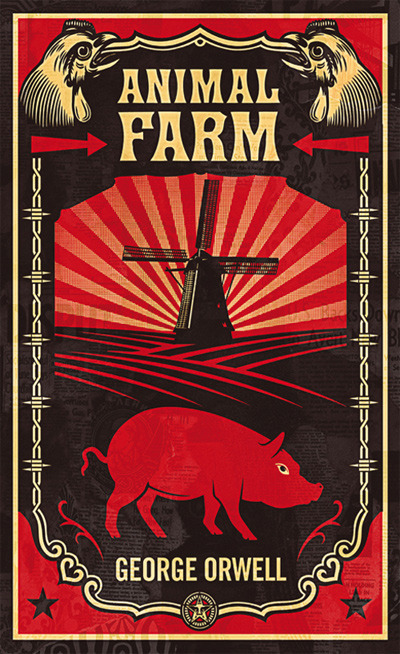
LITERATURE: Animal Farm - George Orwell


(My computer broke down, so while it is being repaired I will post an old review I put up on my tumblr several months ago).

It is a considerably rare event to find and read a book as profound as it is short. Not many authors are capable of expressing sophisticated ideas in very few words.

Reading George Orwell’s Animal Farm took no more than a few hours out of my day, but its length is of no detriment to its quality - what it lacks in length, it makes up for in density. Animal Farm is a story of farm animals who congregate to overthrow the abusive human farmers in an attempt to create an animal run Utopia, which happens to be based primarily on the principles of Marxism - dubbed “Animalism”. Of course, there is some debate as to exactly how this should be done, and corruption is rife. As a result, Animal Farm becomes the simplest answer to the question of why communism was “a good idea which didn’t work”.

Orwell is perhaps better known for his final novel, Nineteen Eighty-Four, a longer, more sophisticated, and more literal exploration of very similar themes - in fact, the parallels between the two novels is at times uncanny. Animal Farm’s pigs take control of the new animal farm and slowly deliver it into an autocratic society, using techniques employed by The Party and Ingsoc in Nineteen Eighty-Four. One may easily draw the connections between the character of Snowball in Animal Farm to the character of Emmanuel Goldstein in Nineteen Eighty-Four, for example (of course, the more obvious comparison is that of Napoleon to Big Brother, however this is almost too obvious and generic to make any kind of substantial point). Additionally, both portray a society where its members are unable to speak their mind, and both show a certain alteration of the past through manipulation of memory. By the end ofAnimal Farm, no character can recall whether the current state of affairs is better or worse than before the Revolution - overall, both novels depict a very similar kind of society. 

Written several years before his last novel, Animal Farm can be considered a spiritual predecessor to Nineteen Eighty-Four. Having read the former only after already becoming acquainted with the latterI found Animal Farm difficult to read without comparing the two. The thematic elements are so similar that it is impossible not to. This is not to say that Orwell merely recycled his ideas and lacks originality - this is far from the case. While they are uncannily similar in many aspects, they attack the same ideas from very different angles. In some ways, Animal Farm is an explanation of the backstory of the latter novel, and in this respect it could be considered an analogical prologue to Nineteen Eighty-Four, or a lead-up to the events of it - whileAnimal Farm shows how the society came to be, 1984 shows a character’s attempt to escape from it. Additionally, Nineteen Eighty-Four is primarily character-based, while it’s predecessor is primarily event-based.

Animal Farm is also unlike its rather bleak counterpart with its incorporation of irony and wit, most finely illustrated in the final policy of Animalism: “All animals are equal, but some animals are more equal than others”. There are many other instances of humour, such as the caricature of the sheep as the blind followers.
Despite its employment of humour, Animal Farm certainly carries a very sinister tone - far more sinister than Nineteen Eighty-Four - undeniably due to the explicit portrayal of corruption and the decay of a democratic and free society, and possibly due to the evocation of empathy from readers by using animals as characters (Orwell’s affection for animals shows through quite prominently). Orwell’s application of irony most definitely contributes to the sinister tone - consider, for example the following passage:

About this time there occurred a strange incident which hardly anyone was able to understand. One night at about twelve o’clock there was a loud crash in the yard, and the animals rushed out of their stalls. It was a moonlight night. At the foot of the end wall of the big barn, where the Seven Commandments were written, there lay a ladder broken in two pieces. Squealer (one of the pigs), temporarily stunned, was sprawling beside it, and near at hand there lay a lantern, a paintbrush, and an overturned pot of white paint. The dogs immediately made a ring round Squealer, and escorted him back to the farmhouse as soon as he was able to walk. None of the animals could form any idea as to what this meant, except old Benjamin, who nodded his muzzle with a knowing air, and seemed to understand, but would say nothing. 
But a few days later Muriel (the goat), reading over the Seven Commandments to herself, noticed that there was yet another of them which the animals had remembered wrong. They had thought the Fifth Commandment was “No animals shall drink alcohol,” but there were two words that they had forgotten. Actually the Commandment read: “No animal shall drink alcohol to excess.

Orwell’s here states quite plainly the events that happened, yet does not explain their obvious implications. Here none of the animals can discern the true meaning of what they behold, but we as readers can see quite clearly how the pigs are altering the Commandments, and influencing the rest of the animals to believe the fault lies merely with their recollection of them. At this, one may feel frustration in the same way one may feel inclined to yell advice at a well-intentioned yet unbelievably stupid TV character. This concept is, in my opinion, one of Orwell’s finest exploits, and is a central component to the story of Nineteen Eighty-Four.

To refrain from comparing Animal Farm to its Big Brother for a moment: it is an acute exploration of power, politics, and human nature with respect to the above. It is obviously a criticism of the Soviet regime of the time, and a somewhat prophetic depiction of its failure: the end shows the pigs walking on two legs (a betrayal of the principles of Animalism at its core, summarized by the sheep who echo “Four feet bad, two feet good!”), and behaving like humans to the point where they are indistinguishable from humans. The Animal Farm has come full circle - in the attempt to create a society free from human oppression, they end up back where they started. As the book progresses, it becomes increasingly bleak and cynical, and almost depressingly nihilistic. I say almost - not quite, and it depends on the interpreter. But the story’s conclusion almost comes across as expressing the futility of attempting to advocate real change.

Remembering also the length of the book, you have to stand in awe at its capacity for depth and density. Animal Farm accomplishes what most authors couldn’t in twice the words. Having said  that, it merely scratches the surface of what the literary onslaught Nineteen Eighty-Four manages to say. Despite it’s genius, Animal Farm is an incomplete expression of Orwell’s ideas, one which is completed with Nineteen Eighty-Four. 

I do not wish to judge this book too much by how it compares to it’s successor; however, I feel that the similarities and parallels are too frequent to avoid completely. On its own merits, however, Animal Farm is a rich, multi-faceted exploration of several ideas, and you would do yourself a disservice not to read it. And considering its length, anyone is able to finish it over the course of one day, or even in one - albeit long - sitting. While it may be difficult to discern what its intended message is, which will no doubt be different for every reader, it is certainly an illustration of the crude, clichéd, and yet somewhat true saying: “Absolute power corrupts absolutely.”