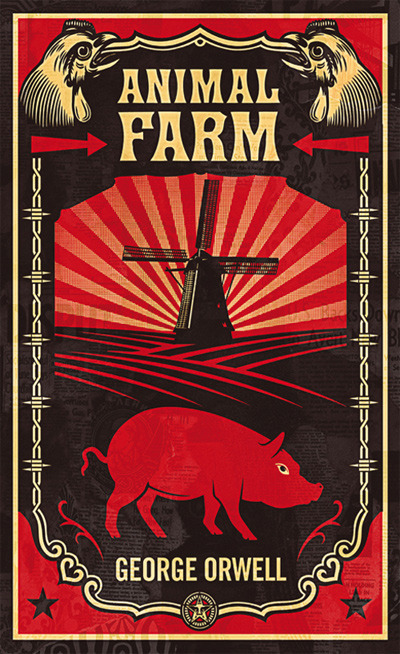
(My computer broke down, so while it is being repaired I will post an
old review I put up on my tumblr several months ago).
It is a considerably rare event to find and read a book as profound as
it is short. Not many authors are capable of expressing sophisticated ideas in
very few words.
Reading George Orwell’s Animal Farm took no more than a
few hours out of my day, but its length is of no detriment to its quality -
what it lacks in length, it makes up for in density. Animal Farm is
a story of farm animals who congregate to overthrow the abusive human farmers
in an attempt to create an animal run Utopia, which happens to be based
primarily on the principles of Marxism - dubbed “Animalism”. Of course, there
is some debate as to exactly how this should be done, and corruption is rife.
As a result, Animal Farm becomes the simplest answer to the
question of why communism was “a good idea which didn’t work”.
Orwell is perhaps better known for his final novel, Nineteen
Eighty-Four, a longer, more sophisticated, and more literal
exploration of very similar themes - in fact, the parallels between the two
novels is at times uncanny. Animal Farm’s pigs take control of the
new animal farm and slowly deliver it into an autocratic society, using
techniques employed by The Party and Ingsoc in Nineteen
Eighty-Four. One may easily draw the connections between the character
of Snowball in Animal Farm to the character of Emmanuel
Goldstein in Nineteen Eighty-Four, for example (of course, the
more obvious comparison is that of Napoleon to Big Brother, however this is
almost too obvious and generic to make any kind of substantial point). Additionally,
both portray a society where its members are unable to speak their mind, and
both show a certain alteration of the past through manipulation of memory. By
the end ofAnimal Farm, no character can recall whether the current
state of affairs is better or worse than before the Revolution - overall, both
novels depict a very similar kind of society.
Written several years before his last novel, Animal Farm can
be considered a spiritual predecessor to Nineteen Eighty-Four. Having
read the former only after already becoming acquainted with the latter, I
found Animal Farm difficult to read without comparing the two.
The thematic elements are so similar that it is impossible not to. This is not
to say that Orwell merely recycled his ideas and lacks originality - this is
far from the case. While they are uncannily similar in many aspects, they
attack the same ideas from very different angles. In some ways, Animal
Farm is an explanation of the backstory of the latter novel, and in
this respect it could be considered an analogical prologue to Nineteen
Eighty-Four, or a lead-up to the events of it - whileAnimal
Farm shows how the society came to be, 1984 shows a
character’s attempt to escape from it. Additionally, Nineteen
Eighty-Four is primarily character-based, while it’s predecessor is
primarily event-based.
Animal Farm is also unlike its rather
bleak counterpart with its incorporation of irony and wit, most finely
illustrated in the final policy of Animalism: “All animals are equal, but some
animals are more equal than others”. There are many other instances of humour,
such as the caricature of the sheep as the blind followers.
Despite its employment of humour, Animal Farm certainly
carries a very sinister tone - far more sinister than Nineteen
Eighty-Four - undeniably due to the explicit portrayal of corruption
and the decay of a democratic and free society, and possibly due to the
evocation of empathy from readers by using animals as characters (Orwell’s
affection for animals shows through quite prominently). Orwell’s application of
irony most definitely contributes to the sinister tone - consider, for example
the following passage:
About this time there occurred a strange incident which hardly anyone was able to understand. One night at about twelve o’clock there was a loud crash in the yard, and the animals rushed out of their stalls. It was a moonlight night. At the foot of the end wall of the big barn, where the Seven Commandments were written, there lay a ladder broken in two pieces. Squealer (one of the pigs), temporarily stunned, was sprawling beside it, and near at hand there lay a lantern, a paintbrush, and an overturned pot of white paint. The dogs immediately made a ring round Squealer, and escorted him back to the farmhouse as soon as he was able to walk. None of the animals could form any idea as to what this meant, except old Benjamin, who nodded his muzzle with a knowing air, and seemed to understand, but would say nothing.
But a few days later Muriel (the goat), reading over the Seven Commandments to herself, noticed that there was yet another of them which the animals had remembered wrong. They had thought the Fifth Commandment was “No animals shall drink alcohol,” but there were two words that they had forgotten. Actually the Commandment read: “No animal shall drink alcohol to excess.”
Orwell’s here states quite plainly the events that happened, yet does
not explain their obvious implications. Here none of the animals can discern
the true meaning of what they behold, but we as readers can see quite clearly
how the pigs are altering the Commandments, and influencing the rest of the
animals to believe the fault lies merely with their recollection of them. At
this, one may feel frustration in the same way one may feel inclined to yell
advice at a well-intentioned yet unbelievably stupid TV character. This concept
is, in my opinion, one of Orwell’s finest exploits, and is a central component
to the story of Nineteen Eighty-Four.
To refrain from comparing Animal Farm to its Big
Brother for a moment: it is an acute exploration of power, politics, and human
nature with respect to the above. It is obviously a criticism of the Soviet
regime of the time, and a somewhat prophetic depiction of its failure: the end
shows the pigs walking on two legs (a betrayal of the principles of Animalism
at its core, summarized by the sheep who echo “Four feet bad, two feet good!”),
and behaving like humans to the point where they are indistinguishable from
humans. The Animal Farm has come full circle - in the attempt to create a
society free from human oppression, they end up back where they started. As the
book progresses, it becomes increasingly bleak and cynical, and almost
depressingly nihilistic. I say almost - not quite, and it depends on the
interpreter. But the story’s conclusion almost comes across as expressing the
futility of attempting to advocate real change.
Remembering also the length of the book, you have to stand in awe at its
capacity for depth and density. Animal Farm accomplishes what
most authors couldn’t in twice the words. Having said that, it merely
scratches the surface of what the literary onslaught Nineteen
Eighty-Four manages to say. Despite it’s genius, Animal
Farm is an incomplete expression of Orwell’s ideas, one which is
completed with Nineteen Eighty-Four.
I do not wish to judge this book too much by how
it compares to it’s successor; however, I feel that the similarities and
parallels are too frequent to avoid completely. On its own merits,
however, Animal Farm is a rich, multi-faceted exploration of
several ideas, and you would do yourself a disservice not to read it. And
considering its length, anyone is able to finish it over the course of one day,
or even in one - albeit long - sitting. While it may be difficult to discern
what its intended message is, which will no doubt be different for every
reader, it is certainly an illustration of the crude, clichéd, and yet somewhat
true saying: “Absolute power corrupts absolutely.”

No comments:
Post a Comment