The trouble with film adaptations of popular literary works is that fans of the original book place such strong emphasis on recreating their favorite text - as a result, any deviations from the original story a film adaptation may take are harshly criticized by audiences. Placing such high priority on simple recreation of a text is problematic for a number of reasons; namely, the audience will ignore or dismiss an inherently good film simply because it fails to capture the original story exactly. More often than not, the medium translation simply will not allow an exact replica of a book, and adjustments are necessary. Other times, filmmakers seek not to regurgitate a popular story, but to deliberately change it in order to tell the story their own way. Whether or not a film adaptation of a book takes liberties with the original text is irrelevant - unfortunately, claims that “the book is better than the film” are blinded to this fact. Adaptational films are not judged on their own merits, and are instead judged on the basis of whether they follow the source text accurately. Fortunately, I never read Stephenie Meyer’s The Host, so I went into the film able only to judge the film independent of the original novel - which I believe is the only way to judge a film adaptation.
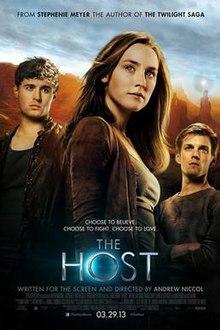
The Host is an adaptation of Stephenie Meyer’s novel of the same name, who also wrote the Twilight series of novels. Meyer’s affiliation with Mormonism has undermined her credibility to an extent, with Twilight supposedly intended to be a metaphor for the virtue of purity and fidelity, (which kind of failed with the ensuing fanbase) so I went into The Host partially wondering where the Mormon significance lay. With a lack of knowledge of the nuances of Mormonism, though, it was difficult to spot; additionally, the possibility that the filmmakers subordinated the religious point was present.
The Host is a film by Andrew Niccol, who also directed Gattaca in 1997, set in a post-apocalyptic future where an alien parasitic race has invaded to possess and utilise human bodies in order to build a perfect utopia on Earth, of eternal peace and free of war, hate, and conflict. Unfortunately, being possessed by these aliens (who are referred to as “Souls”) renders the human unconscious, and therefore nothing more than a vehicle for the Souls. Melanie Stryder is a young woman captured by the colonial aliens and infected with a Soul named Wanderer. However, for some reason, Melanie remains conscious throughout her possession by the Wanderer, and as such can communicate with Wanderer with her thoughts, attempting to dissuade it from following its duty to the colonisation effort. This is a concept I found surprisingly compelling, and I found these dark undertones thoroughly intriguing from the beginning of the film.
However, this is a film I found particularly difficult to classify; at times, it feels like a thriller, at others it feels like a drama, a science-fiction, a fantasy, and even a romance. Rather than attempt to blend the above genres together, the film has opted instead to cycle through them, resulting in several jarring tone shifts and an altogether inconsistent feel. The opening played like a thriller, with a fitting soundtrack and a commendable use of tension - however, not ten minutes in, once Melanie was captured and infected, the music score shifted to an uplifting piece, all tension was gone and the film became a fantasy. After one hour, it shifted to romance. I can’t shake the feeling that if the film maintained a consistent tone, it could have been quite excellent.
In addition to the inconsistent tone, or perhaps in spite of it, the film doesn’t appear have a central focus. I couldn’t tell whether the main point of the film was the concept of colonisation, the inner conflict between Melanie and her brain parasite, the importance of thinking differently and doing what’s right, the human rebellion’s struggle or the romance. As a result of this lack of focus, none of these aspects were particularly compelling. Each and every one of these concepts (with the possible exception of the romance) is a great opportunity for in-depth exploration individually, but the film’s attempt to focus on all of them results in a failure to focus on any of them.
For example, I felt a great opportunity was missed to explore the inner conflict and dual personality between Melanie and Wanderer. The latter is completely and utterly dedicated to the Souls’ colonization cause, and Melanie is entirely devoted to stopping Wanderer and by extension, the entire alien invasion. Both characters fit neatly on opposite ends of the sliding scale of idealism versus cynicism, with Melanie representing idealistic humanism and empathy, and Wanderer representing cynical misanthropy and cold execution of duty. There are reasonable cases on both sides, and this could have been a fantastic opportunity to explore an ideological struggle between the two minds in the one body, with the duality the sole link between the two species. But no - Wanderer changes heart within the first half hour or so, and that whole idea is abandoned almost instantly. There is no dialogue whatsoever showing why Wanderer would switch sides, and as such the character fails to be believable in the slightest.
Initially, I thought The Host was inherently cynical, as it portrayed the utopia resulting from the alien invasion in a primarily negative, distinctly Orwellian light. However upon reflection, The Host appears to lean more on the side of idealism, with quips about hope and retribution of humanity. In fact, this film is so incredibly idealistic that it borders on sickening, with the overall conclusion that humanity can strive to overcome it’s flaws, which is naïve at best. The problem with “inspiring” tales such as this one is that their hopeless idealism comes across as unrealistic and unattainable, and therefore fails to inspire, which is why an explicit conflict between these two perspectives is necessary for either one to be believable. Actually, I can’t recall any conflicting dialogue between any characters. There’s conflict of interest, but it isn’t resolved convincingly. Within five minutes of screen time, any conflict you may have seen has been resolved and forgotten, somehow. This is not good storytelling. For us to feel any sense of connection and affinity with film characters, they need to be plausible human beings, and not one-dimensional plot devices (as most of the characters in The Host are).
The novel has been marketed as a romance for several years now, and as such it’s fitting that a major part of the film is the romantic interactions. It should not be a surprise, then, that the romance is the least interesting aspect of the film, while being the most prominent. There is a very simple reason for this: romance by its very nature is a deeply personal thing. When portrayed in multimedia, it is either too specific to the depicted characters to be relatable, or too generic and clichéd to be believable. In both cases, the romance fails to be interesting. Before I go on, I should mention that the Souls are completely gender neutral, and are assigned no gender other than that of the body they happen to be possessing at the time - thereby, it makes no sense that a human male should fall in love with it, and even less that it should happen to return said love.
It is a shame that romance is portrayed as central to the film’s concept, because it’s also the most boring part of the film. The Host relies entirely on sentiment for it’s weight, but forgets to establish it’s characters in the first place, making it impossible for the audience to care about the characters and hence the sentimentality fails tremendously. If we, the audience, have no emotional investment in the characters, then any attempt at sentiment will fail, and we cannot have emotional investment in characters which are one-dimensional and incomplete.
As a result, the romance is incredibly boring. Whenever a romantic scene played on the screen, with love interests interacting as they do, all I could think was “am I supposed to care about this?” And if I am asking this question, the film has obviously failed in its purpose. Moreover, the characters themselves are shallow, and I think there’s a compelling case to be made about The Host objectifying women. While the male characters were previously hostile to the Souls, submitting the human race to cold-blooded assimilation and genocide, the minute it possesses the body of an attractive young woman the men turn soft and affectionate. One even goes so far as to fall in love with Wanderer. It makes no sense, and it is made more confusing with the fact that both male love interests look and act almost identical to each other, and it took me a while to fully understand what was going on. The ultimate flaw in this regard, however, is this: it attempts to portray love as central and important to the film, but fails to understand what love really is - other than an elementary, shallow, high-school-drama understanding of the concept. As such, it kind of plays like Twilight: future edition.
The Host starts out with an intriguing premise, but falls short by focussing on petty romance and sentimentality to propel it, rather than the big picture themes which are presented but not resolved. It is therefore a shallow and boring film which doesn’t really have a place in the modern film industry. That’s not to say it’s not worth a look if one happens to be curious, as it does have some interesting ideas happening, but it’s not worth paying for. See it for free if you can, otherwise I cannot recommend.

No comments:
Post a Comment