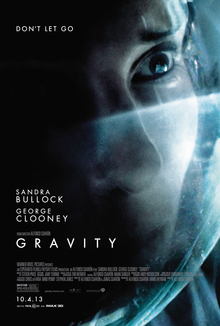
Space is big. Space is cold. Space is empty. Space is lonely.
Yet far too many science fiction films attempt to fill space with many colourful and interesting creatures, places, and phenomena. This is fine, but it misses the true nature of space. Gravity is the first film I have seen which truly conveys how insanely vast, and empty space really is.
It is refreshing to see some original intellectual property in 2013, a year which has been plagued with sequels and remakes. I went into Gravity knowing nothing about it, other than its name and that it is an original story, and that is often enough for me to see a film. As someone who dislikes 3D, I can sincerely say that Gravity is probably the first film where the 3D effect added something to the experience. In 3D, the Earth sits behind the screen, which makes it appear as massive as it should. This is a film that understands scope and scale, and illustrates it well, something science fiction has hitherto struggled with. Unlike the majority of the sci-fi films released this year, the visuals in Gravity serve the story, and not the other way round. On top of this, watching Gravity in 3D fake depth does make the events feel more tangible and real than it would in 2D, which is important because the major selling point of Gravity relies on the audience begin able to connect with the events on screen.
That is tension. Gravity is an immensely intense experience. Not only does it present us with a vast abyss, but it throws us into it with the on-screen characters. I lost count of how many times my heart stopped because someone lost grip on the outer hull of a spacecraft, with the ever looming threat of being cast into the void, inertia carrying you infinitely into nothingness until you die. This would not be as powerful if the film did not draw the audience in as effectively as it does. 3D is but one technique which accomplishes this. The first twenty-or-so minutes of Gravity is one continuous take, rotating about all axes to make it clear that direction is irrelevant in space where there is no gravity, illustrating how disorienting space is. It makes us feel almost as though we are actually there, and the way the camera moves into Stone’s helmet to give us a first person perspective, and back out again, in the one take is nothing short of brilliant. Effective use of silence creates a chillingly tense atmosphere. Watching someone be cast into the depths of space in complete silence is terrifying.
It is important to understand what we’re dealing with here. To watch Ryan Stone fly into deep space alone, against a backdrop of thousands of stars, is scary if you know exactly what is at stake. First, look at all the stars behind her. At her speed, it would take millions of years for her to reach the nearest star. From there, it would take yet more millions of years to reach the next nearest star. That is how insanely vast and empty space really is - and every time someone slips on the outer hull of the ISS, they risk being cast eternally into such a fate. With a relatively simple grasp of the concept of inertia, one must also understand that in space even a tiny pebble can have destructive power on a catastrophic level, provided it is moving at a sufficient velocity. Gravity depicts a situation where the smallest mistake can be devastating, and as such, the fates of all the characters sit on a knife edge. We see many films where this is a factor, but never before has it been so real on screen, and the way Gravity immerses the audience into the story combined with constant awareness of the stakes evokes a powerful anxiety within the viewer. It draws you into this fearful predicament so powerfully that one begins to feel true anxiety and fear for the events on screen. That is why Gravity is a chilling and scary experience.
Articulating one’s thoughts about Gravity is difficult, because the reactions are almost entirely emotional. It reminds me somewhat of Cloverfield, in the sense that the emotional high is so profoundly affecting that the flaws can be - and are - overlooked. It is a fair stretch from horror territory, but most certainly sits within the realm of thrillers, relying less on overt terror and more on underlying anxiety. Gravity should rightfully steal Alien’s tagline: “In space, no one can hear you scream”. The catalyst for fear in Alien was the titular alien; however, Gravity manages to evoke the same level of fear using nothing but the emptiness of space. No creatures, no aliens, no horrible and unimaginable monstrosities - just black, empty space, and the laws of physics. Gravity shows us our real place in the universe; as the 3D manages to present an incredible sense of scale on a TV screen, making the Earth appear massive (as it should), it also shows us how incredibly tiny the Earth really is compared to space - and where does that leave us? The fear is more-or-less existential to a certain degree.
The realistic nature of the film’s premise does add to the level of believability and plausibility, which is an essential aspect of a film such as this one, where audience participation is necessary, as willing suspension of disbelief is paramount for the audience to feel involved. However, it does suffer from the problem where the closer a film approaches realism, the more glaring its mistakes become. In other words, the more a film tries to be realistic, the occasional unrealistic and unbelievable element is enough to undermine the credibility of the story and derail the entire experience. Whereas something like Star Wars, which is completely beyond the realm of plausibility, manages to get away with a lack of realism because it never tried to be plausible in the first place - a film such as Gravity, on the other hand must take extra care to get the science right. Sound in space comes to mind, however seeing as it doesn’t directly affect the plot, it is a negligible misstep. I’m sure there are other factors which are scientifically inaccurate, but as I said earlier, the emotional involvement is enough to compensate.
For a while, I thought this film would end with a lonely person dying alone in the most lonely place in the universe - space. It would have been fitting and consistent with the running theme up to that point. The eventual turn for the saccharine, wherein Stone manages to defy Murphy’s Law and land on Earth alive, was initially unwelcome.The way the film suddenly becomes a heartwarming survival story with a happy ending is inconsistent with the cold and brutal depiction of space previously seen - it is a sudden and jarring tone shift which doesn’t do the film a whole lot of favours. However, we need to understand what Gravity is trying to be - and in this case, it is a story of survival against all odds, rather than one of despair and death. In this sense, Gravity is still a very good film in its own right, but I personally feel it could have been more powerful if she had died in space; it makes more sense. It could have ended better.
It is also important to note that, barring the final five minutes, the entire film is set in zero gravity. The overall message of the film appears to be that mankind does not, and should not, belong anywhere but Earth, and space exploration is pointless. I cannot agree with this sentiment, although I am not certain it was the intended message - assuming, of course, there even was an intended message. I also feel they went overboard on the orchestral backing music, as the film is far more powerful in silence than otherwise, and properly depicting the absence of sound in space would have truly added to the experience.
However, these gripes are immaterial. This film is a mere ninety minutes long, however it feels far, far longer. Not in the sense that it is boring, or drags on too much - but in that the depth of experience more than compensates for the terseness of the film. It does a lot with a short run time, and this feat alone is commendable. In short, Gravity is a phenomenal, gut-wrenching, anxiety-inducing and incredibly intense science fiction thriller.

No comments:
Post a Comment